We moved a button three inches and it led to 212 more move-ins.
We took the primary call-to-action in a client's tour-booking email and moved it higher above the fold, visible without scrolling on both desktop and mobile.
Everything else was the same, the copy, the subject line, the audience.
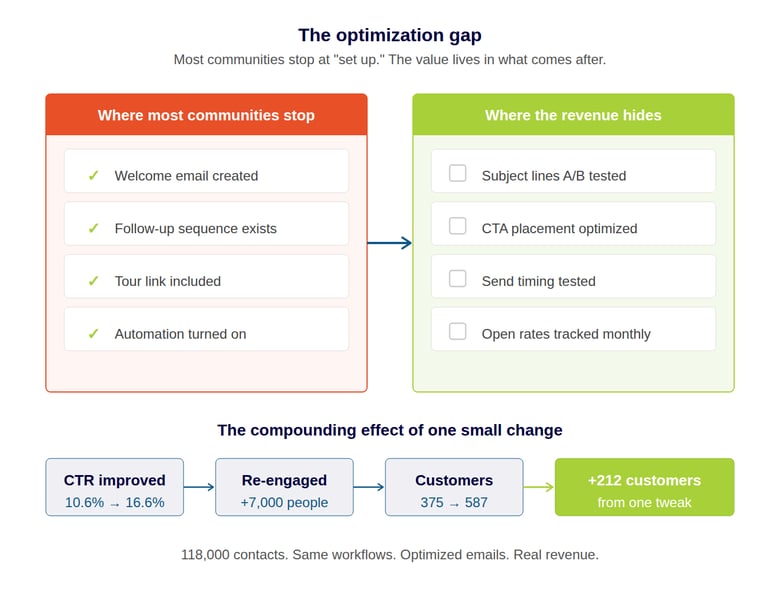
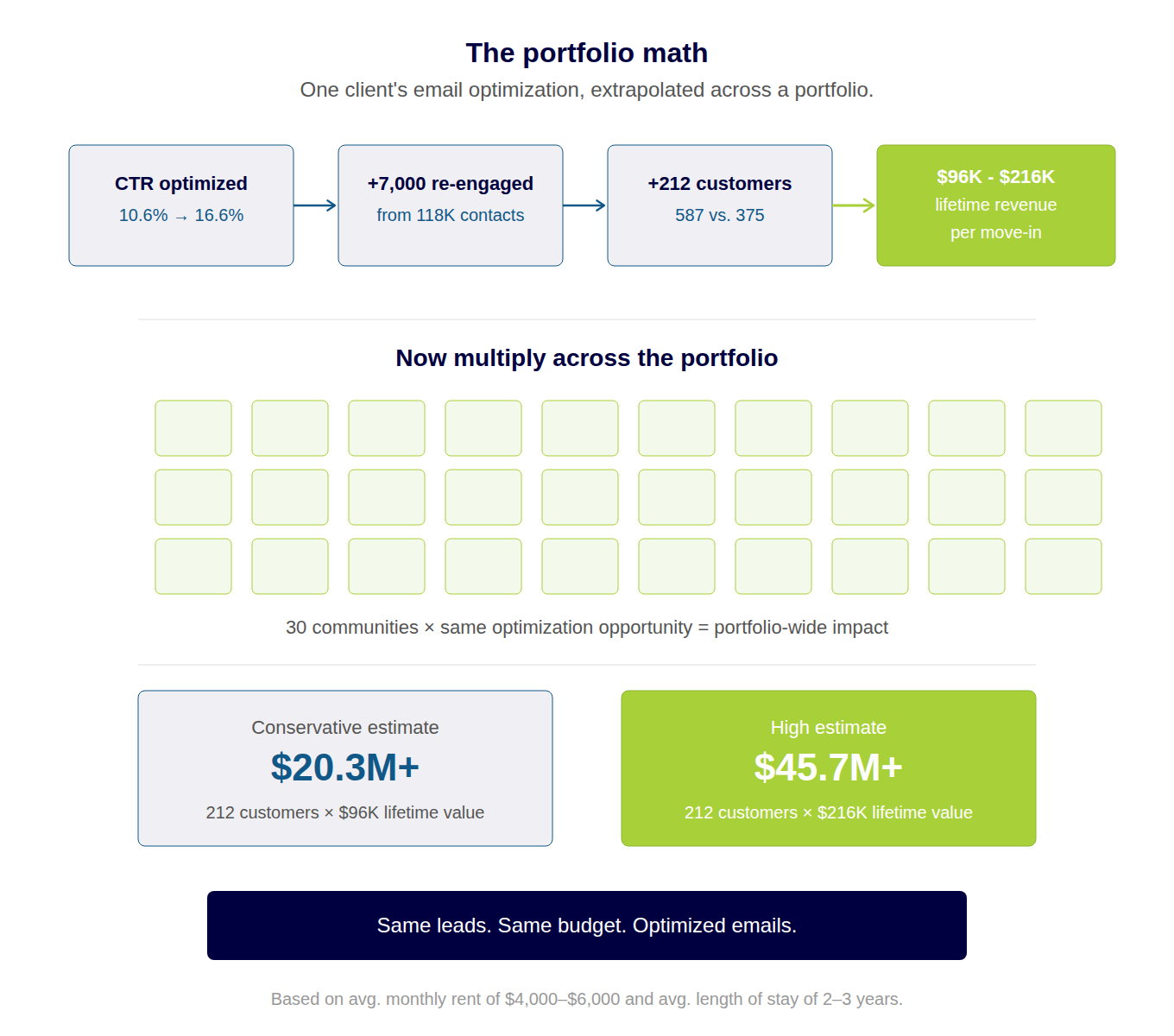
The cumulative result: click-through rates went from 10.6% to 16.6%.
Out of 118,000 contacts enrolled in those workflows, that 6-point improvement led to roughly 7,000 more people re-engaging with the website.
The end result was 587 customers instead of 375.
212 additional customers just from optimizing emails they were already sending to leads they already had.
This kind of improvement is available to virtually every senior living community running email nurture sequences today but almost none of them are pursuing it at the level of detail it takes to create these results.
The optimization gap nobody talks about
Most senior living operators have some version of an email nurture sequence in place.
When a prospect fills out a form or expresses interest, they receive some automated follow-up. Maybe it's a welcome email, maybe a few follow-ups over the next week or two, maybe a link to schedule a tour.
The existence of the sequence is where most communities stop.
Whether the subject line is performing well, whether the emails are actually being opened, whether the CTA placement is optimized for mobile, whether the send timing matches when prospects are most likely to engage, none of that gets examined.
The sequence runs on autopilot and nobody touches it again until someone decides to rebuild the whole thing from scratch a year later.
Why communities can't do this internally
The problem most senior living operators face is that they don't have someone internally that either:
- Has the expertise to do this level of granular split testing, understands the tech, and has the experience in senior living across all types of communities to understand what's working and evolving
- Has the time to do it between all the other functions of their role.
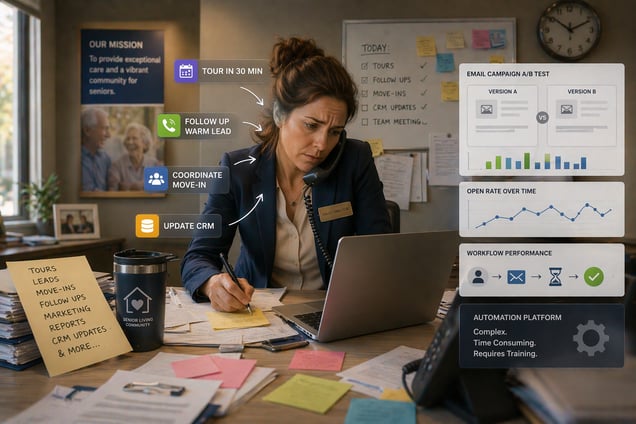
The sales director at a community is handling tours, following up with warm leads, coordinating move-ins, and updating the CRM.
Asking that same person to also log into the marketing automation platform, set up A/B tests on email subject lines, monitor open rates over a two-week window, analyze the results, and then iterate is not going to work.
Most communities don't have a dedicated marketing operations person.
They have a sales director who also handles marketing, or a regional marketing lead who covers a dozen properties and doesn't have time to optimize at the individual workflow level.
The tools themselves add another layer of difficulty.
Platforms like HubSpot, ActiveCampaign, and Marketo are powerful, but they're complex. Setting up a proper A/B test requires understanding statistical significance, sample sizes, and what to actually measure. Most community-level staff haven't been trained on this, and even if they have, there's no time in the day to do it consistently.
So the sequences run as-is.
What micro-optimization actually looks like
Micro-optimization isn't about rebuilding everything, it’s about making small, testable changes to what already exists and measuring whether they move the needle.
In practice, this means things like:
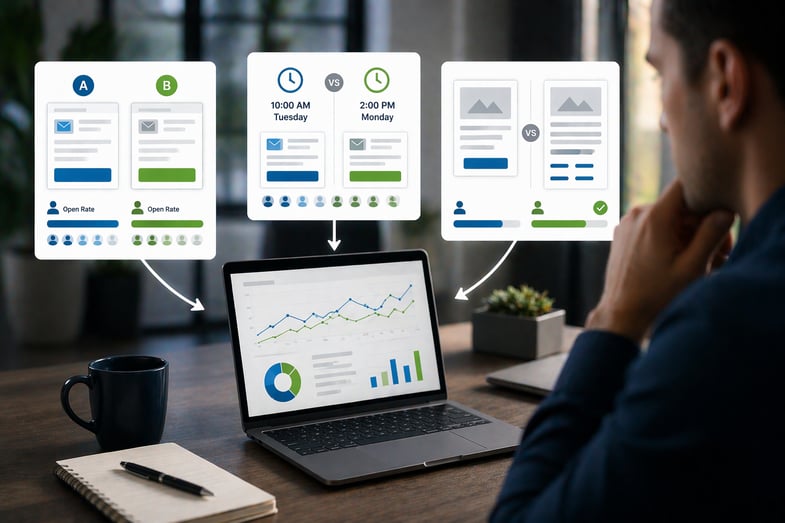
- Testing two subject lines against each other for two weeks and seeing which one generates more opens.
- Checking whether an email sent at 10am on Tuesday performs differently than one sent at 2pm on Monday.
- Looking at whether a shorter email with a single clear CTA outperforms a longer one with multiple links.
- Moving that CTA above the fold and measuring whether more people click.
Each of these changes in isolation looks minor, but these metrics compound.
A higher open rate means more people see the email, and more people seeing the email means more clicks, which then means more tour scheduling page visits, more tours, and ultimately more move-ins. It’s math!
The cumulative effect of dozens of small changes applied consistently over the course of a year can make a massive difference on your bottom line.
The portfolio math
This is where operators and investors managing multiple communities should pay attention.
If for just one set of email workflows and 118,000 contacts a 6-point improvement in click-through rate leads to 212 additional customers, then:
At an average monthly rent of $4,000 to $6,000 and an average length of stay of two to three years, a single move-in represents $96,000 to $216,000 in lifetime revenue.
Even a fraction of those 212 additional customers converting to move-ins represents millions in revenue that would not have existed without the optimization work.
Now extrapolate that across a portfolio of 20 or 30 communities, each with their own lead nurture workflows running on autopilot. If every community has the same kind of untapped opportunity sitting inside its email sequences, and in our experience, the portfolio-wide impact of systematic optimization is substantial.
There are dozens of variables sitting inside any operator's existing lead nurture system that can be tested and improved. Subject lines, send times, CTA placement, email length, personalization, the number of touches in a sequence, the timing between them. Each one is a lever.
By treating nurture optimization as an ongoing discipline rather than a one-time setup, you can extract significantly more value from the same lead spend.
What most operators don't realize about their own data
One of the things we've observed working across multiple senior living portfolios is that most operators can't tell you their open rate, click-through rate, or any metrics regarding their nurture sequences. They don't know how many of their tours were influenced by a nurture email versus a direct phone call.
This isn't a criticism, it’s just a reality that when nobody owns optimization, nobody measures the inputs that optimization requires.
But the data is there, sitting inside the CRM and the marketing platform, waiting for someone to look at it. And when someone does look at it when someone actually pulls the click-through rates, segments them by community, compares subject line performance, and tracks engagement to tour booking, the picture becomes very clear very quickly.
The hard part isn't finding these opportunities, it’s just having someone whose job it is to look.
Key takeaways
↳ Improving click-through rate on email nurture workflows from 10.6% to 16.6% produced 212 additional customers out of 118,000 contacts. That came from dozens of small optimizations, including moving a CTA three inches, applied consistently over the course of a year.
↳ Most senior living communities have nurture sequences in place but nobody optimizing them. The gap between "having a sequence" and "optimizing a sequence" is where significant revenue hides.
↳ Sales directors don't have time to A/B test emails, analyze click-through rates, or tweak workflows on a micro level. This work requires dedicated resources, either in-house or through a specialist partner.
↳ For portfolio operators and private equity groups, the compounding effect of micro-optimization across dozens of communities and thousands of leads translates to seven-figure revenue impact from improvements that cost almost nothing to implement.
↳ The data to identify these opportunities already exists inside your CRM and marketing platform. The missing piece isn't the data, it's someone whose job it is to look at it and act on it.
Next steps
Pull the open rate and the click-through rate on your top nurture sequence. Ask yourself when was the last time anyone has tried an A/B test on ANY of it?
Want more like this? Subscribe to The Follow-Up, our monthly newsletter with insights on speed-to-lead, follow-up systems, and how to turn inquiries into tours and move-ins.
NextWave helps senior living communities optimize every stage of the lead-to-tour pipeline through the Occupancy Advantage System™. Our team handles the micro-level optimization that community sales directors don't have time for — from nurture sequence testing to CTA placement to send-time analysis — across entire portfolios. Book a call to learn how small improvements in your existing lead flow can produce outsized results.
.webp)
.png)