The average senior living community takes 46 hours to make their first contact attempt with a new lead.
We know this because we secret-shopped over 150 communities across the country. This number keeps showing up. Even worse, 30% of the communities we shopped never responded at all.
Meanwhile, research shows that your odds of qualifying a phone lead drop by 80% after just five minutes. Not five hours. Five minutes.
That gap between what works and what most communities actually do creates an opportunity for any operator willing to close it.
What speed-to-lead measures
Speed-to-lead is the time between when a prospect submits an inquiry and when your team makes first contact. The clock starts the moment that form gets submitted or the phone rings.
This metric matters more in senior living than most industries because families research multiple communities simultaneously.
When someone fills out your contact form, they're likely filling out three to five others at the same time. They're comparing options. They're stressed about a major life decision for themselves or a loved one. And they're going to move forward with whoever helps them first.
The first community to respond with helpful, human contact wins the conversation.
The data behind slow response times
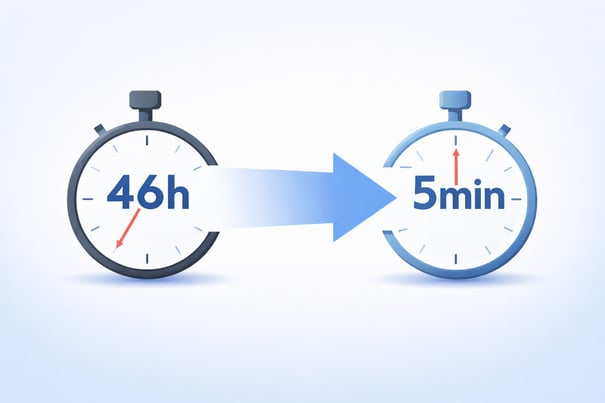
Most communities respond in days, not minutes
Our secret shop data shows the average response time across 150 communities is 46 hours. That's nearly two full business days before a prospect hears from anyone.
Industry research backs this up. According to McKnight's Senior Living, 39% of senior care marketers wait more than 12 hours to respond to a single lead. About half fall in the one to three hour range.
By the time most communities call, the prospect has already toured a competitor, made a decision, or moved on entirely.
What to do: Aim for first contact within five minutes. If you can't staff for that internally, consider automation or an external partner.
Response speed directly impacts conversion rates
Studies show that leads contacted within five minutes are 100 times more likely to convert than those contacted after 30 minutes. Even a 15-minute delay dramatically reduces your chances of booking a tour.
Our clients see a 48% increase in lead-to-tour conversion rates when we implement rapid response systems. Not because the leads got better. Because every lead now gets contacted while they're still thinking about senior living.
What to do: Track your actual response times. Most communities don't know this number. Once you measure it, you can improve it.
Referral leads require immediate response
When a lead comes through A Place for Mom or Caring.com, it goes to multiple communities at once. Everyone receives the same prospect at the same time.
You're paying $400 or more for that lead. So is every competitor who received it.
First to respond gets the conversation. Everyone else hopes the prospect is still looking.
What to do: Route referral leads to a dedicated responder or service that can guarantee immediate contact. Don't let expensive leads sit in a queue.
After-hours inquiries get ignored
More than 22% of senior living inquiries come in after hours or on weekends. Most don't get contacted until the next business day.
That's 24 to 48 hours where a motivated prospect is waiting. And probably already hearing from competitors with weekend coverage.
What to do: Implement after-hours response through automation, a call center, or rotating on-call coverage. Even an automated text with next-step information keeps the prospect engaged.
The "bad leads" problem is actually a follow-up problem

We hear the same thing from sales directors constantly: the leads are bad. The internet leads, the paid ad leads, the inbound inquiries. They're junk. They never convert.
Here's what the data actually shows.
We've tracked thousands of leads across dozens of communities. The average prospect needs 9 touchpoints before they're ready to schedule a tour. Nine separate contacts: calls, emails, texts, or some combination.
The average number of follow-up attempts most communities make? Less than two.
A lead comes in. The sales team makes one call, sends one email, maybe tries again the next day. Then they move on and label it a bad lead.
The leads aren't bad. The follow-up is incomplete.
This connects directly to speed-to-lead. A slow first response is usually a symptom of a bigger problem: there's no system for lead management at all. If nobody owns the first five minutes, nobody owns the next nine touches either.
Communities that respond in 46 hours aren't suddenly disciplined about follow-up after that. The same lack of process that causes slow response also causes premature abandonment of leads that would have converted with consistent contact.
Think about your own behavior when researching a major purchase. How many emails do you ignore before one finally catches you at the right moment? How many times does a company need to reach out before you respond?
Your prospects are the same way. They're dealing with a stressful decision for themselves or a loved one. They're not ready to act after one phone call. They need repeated, helpful contact over time.
The communities that understand this build systems to deliver those 9+ touches automatically. They stop blaming lead quality and start measuring their own follow-up consistency.
Why this problem exists
Speed-to-lead isn't slow because sales directors are lazy. It's slow because the job makes fast response nearly impossible without a system.
Sales directors are busy giving tours
The person responsible for calling new leads is the same person conducting tours, meeting with families, handling move-in logistics, and managing their existing pipeline. When they're showing a family around the community, they're not answering the phone.
A lead that comes in at 10am might not get attention until 3pm because the sales director was in back-to-back tours. By then, the prospect has heard from two competitors.
Leads go to the wrong place
Many communities route web form submissions to a general inbox that gets checked once or twice a day. Or leads go to a CRM that the sales director checks between other tasks. There's no alert, no urgency, no process for immediate response.
Phone inquiries often go to the front desk. The receptionist isn't trained for sales conversations, so they take a message. That message sits until the sales director is available. Meanwhile, the prospect called three other communities and already scheduled a tour somewhere else.
Nobody owns after-hours
A lead that comes in at 6pm on Friday doesn't get touched until Monday morning. That's 60+ hours of silence. The prospect filled out that form because they were actively thinking about senior living. By Monday, they've moved on or made a decision.
Most communities don't have after-hours coverage because nobody has explicitly been assigned to own it. It's not that leadership decided against weekend responses. The question was never formally addressed.
There's no accountability for response time
If you asked most operators what their average speed-to-lead is, they couldn't tell you. It's not tracked. There's no dashboard showing how long leads sit before first contact. Without measurement, there's no accountability. Without accountability, the number drifts toward whatever is convenient for the current workload.
The common thread in all of these problems is the absence of a dedicated system. Lead response is treated as something the sales director handles when they have time, rather than a defined process with clear ownership and measurable standards.
The financial case for fixing this
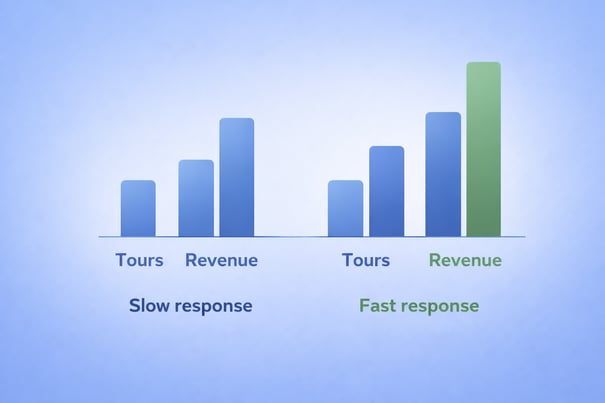
For operators and investors evaluating community performance, lead response time is one of the highest-leverage metrics available. Small improvements translate directly to occupancy and revenue.
The cost of non-response
Our secret shop found that 30% of communities never responded to leads at all. Take a community paying for 50 leads per month at $400 each. That's $20,000 in monthly lead spend.
If 30% of those leads never get a response, that's $6,000 per month going nowhere. Over a year, $72,000 in lead costs with zero chance of conversion.
This doesn't show up as a line item anywhere. It looks like marketing spend that didn't work. But it's not a marketing problem. It's an operational problem.
The cost of slow response
Even among leads that do get contacted, slow response reduces conversion rates substantially. If responding within 5 minutes converts leads at 100x the rate of responding after 30 minutes, the math on 46-hour response times is brutal.
Communities that improve speed-to-lead from 46 hours to under 30 minutes typically see lead-to-tour conversion increase by 40-50%. Same leads. Same marketing spend. More tours.
For a 100-unit community with average monthly rent of $5,000, each additional move-in represents $60,000 in annual revenue. If faster response generates even two additional move-ins per year, that's $120,000 in revenue from an operational change that costs far less to implement.
Portfolio-level impact
For private equity groups and multi-community operators, lead response time is a portfolio-wide performance indicator.
If the average response time across your portfolio is 46 hours and 30% of leads go unanswered, that pattern is costing you occupancy points at every property. The communities complaining about lead quality probably have response time problems. The communities struggling with census probably have follow-up problems.
Fixing lead response at the portfolio level creates measurable improvement in occupancy rates, revenue per community, and overall asset performance. It's one of the few operational changes that can be implemented relatively quickly across multiple properties with standardized processes and centralized accountability.
The data flows directly to the metrics investors care about: occupancy, NOI, and property valuation.
Why this works
Most operational improvements in senior living require significant capital, staffing changes, or months of implementation. Speed-to-lead is different.
The benchmark is so low that responding within 30 minutes puts you ahead of most competitors. Responding within five minutes makes you a standout.
You don't need better leads. You don't need a bigger marketing budget. You don't need to renovate your community.
You need to answer faster.
Communities that do this generate 3x more tours from the same lead flow. They fill units while competitors complain about lead quality.
Key takeaways
↳ The industry average response time is 46 hours. Responding within 30 minutes puts you ahead of most competitors.
↳ Leads contacted within 5 minutes convert at dramatically higher rates than those contacted later.
↳ The "bad leads" complaint usually reflects incomplete follow-up. It takes 9 touchpoints to convert a lead to a tour. Most communities make fewer than 2 attempts.
↳ Slow response is an operational problem, not a staffing problem. Sales directors can't answer leads quickly when they're giving tours, and nobody else owns the process.
↳ For a community spending $20,000/month on leads, 30% non-response equals $72,000/year in wasted spend.
↳ Referral leads from A Place for Mom and Caring.com go to multiple communities simultaneously. First to respond gets the conversation.
↳ After-hours and weekend inquiries represent more than 20% of your leads. Without coverage, you're losing those prospects.
Next steps
If you don't know your current speed-to-lead time, start measuring it. Have someone submit a test inquiry and time how long it takes to get a response.
Then ask yourself: is your current process capable of reaching leads within five minutes? If not, something needs to change. That might mean automation, dedicated staff, or an external partner.
NextWave helps senior living communities improve lead response through the Occupancy Advantage System™. Our clients see 91% faster speed-to-lead and 48% higher lead-to-tour conversion rates. Schedule a conversation to learn how we can help your community respond faster and book more tours.
.webp)
.png)